Why Enterprise Asset Tracking Is Not the Same as Consumer “Find My” Technology
As organizations begin exploring asset tracking, one question often comes up early in the conversation:
“Could we solve this with AirTags or another consumer tracking device?”
It’s a fair question.
Consumer tracking technology has changed expectations around location visibility. Millions of people now use “Find My” devices to keep track of keys, luggage, backpacks, and other personal belongings. They are inexpensive, easy to deploy, and remarkably effective for many personal uses.
So, it’s no surprise that some organizations start there as well. In fact, we’ve spoken with companies that initially piloted consumer tracking devices as they explored ways to gain better visibility into tools, equipment, vehicles, or other valuable assets.
For some simple use cases, they may even provide enough functionality to prove that location visibility has value. But as organizations begin thinking beyond finding an occasional missing asset, they quickly discover they’re solving a very different problem.
The objective is no longer simply knowing where something is. The objective becomes improving how the business operates.
Enterprise Tracking Solves a Different Problem
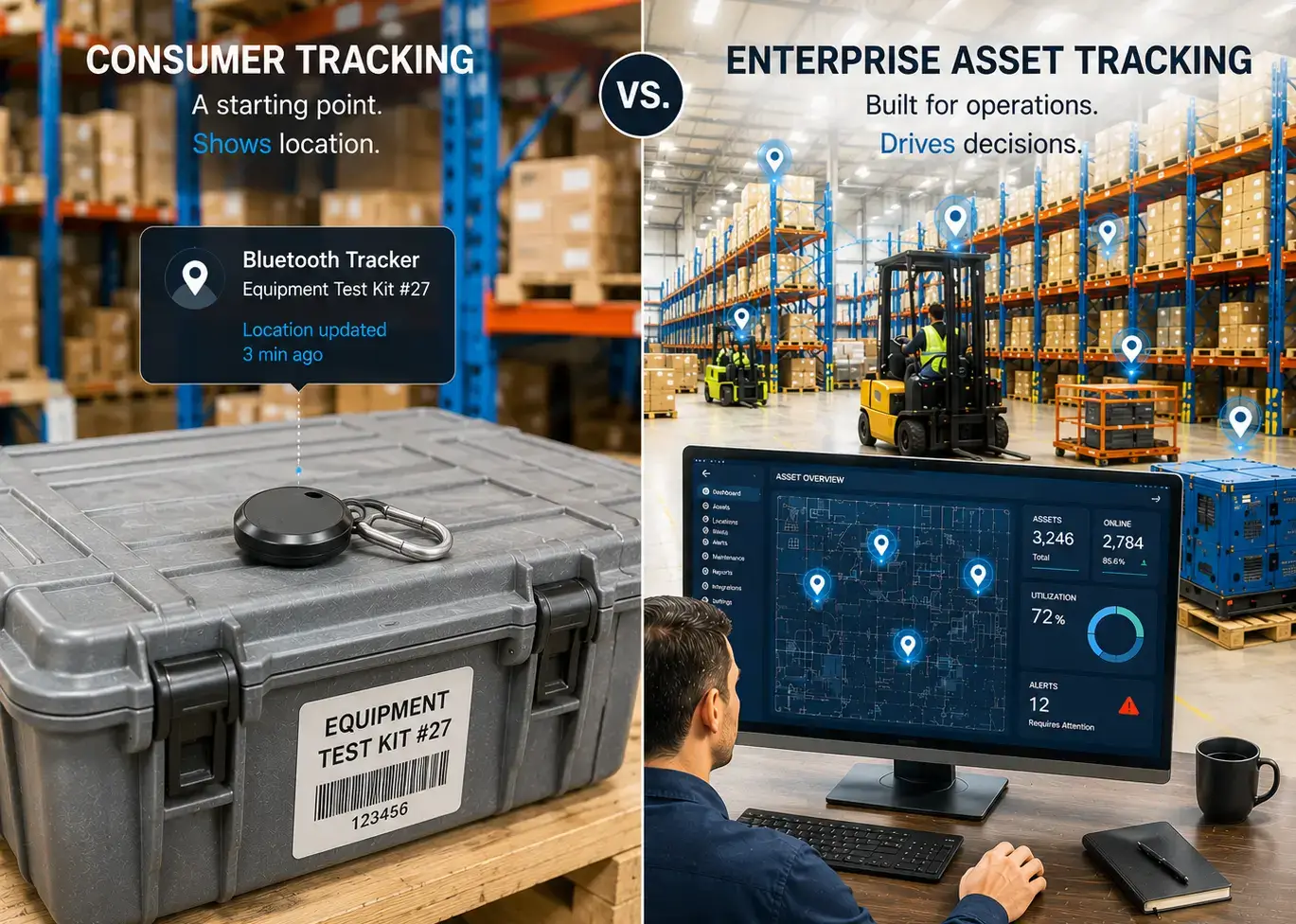
Consumer and enterprise tracking appear to accomplish the same thing: both show where an asset is located. The biggest difference lies in why that information matters.
Consumer tracking is designed to help an individual locate or recover a misplaced item.
Enterprise asset tracking is designed to provide reliable operational data that supports day-to-day business decisions in areas including:
- Operations teams need equipment available when work begins.
- Maintenance teams need visibility into utilization and movement.
- Managers need confidence that assets are where they should be.
- Finance teams rely on accurate inventory and asset accountability.
Location is only the starting point. The real value comes from the business decisions that location data enables.
Business Operations Depend on Trusted Data
As asset tracking becomes part of daily operations, organizations need more than an occasional location update. They need information they can trust. They’re answering operational questions, not simply location questions.
- Can employees quickly locate the nearest available asset?
- Is equipment sitting idle at one location while another site purchases additional inventory?
- Are assets spending more time in storage than in productive use?
- Is equipment consistently arriving where it’s needed on time?
The more organizations rely on tracking data to drive business processes, the more important accuracy, consistency, and reliability become.
Enterprise Environments Present Different Challenges
Enterprise operations are also far more demanding than personal use.
Manufacturing facilities, warehouses, hospitals, airports, construction sites, service fleets, and distribution centers each introduce unique challenges that consumer technologies were never intended to address.
Organizations often need to track hundreds or thousands of assets moving across large facilities, multiple locations, or outdoor environments.
They may require:
- Long battery life
- Continuous visibility throughout operational areas
- Reliable performance indoors and outdoors
- Integration with business systems
- Administrative control and security
- Reporting and analytics
- Scalable device management
These capabilities become essential as tracking evolves from a convenience into part of an organization’s operational infrastructure.
The Goal Is Better Decisions
The biggest shift occurs when organizations stop viewing tracking as a way to recover missing assets. Instead, they begin using location data to improve business performance.
Reliable visibility helps organizations:
- Improve asset utilization
- Reduce unnecessary equipment purchases
- Minimize time spent searching for equipment
- Improve labor productivity
- Increase inventory accuracy
- Support preventative maintenance
- Improve customer service
- Make faster, data-driven operational decisions
Finding a misplaced asset becomes one benefit among many. The larger opportunity is creating visibility that improves how the entire operation functions.
Different Technologies for Different Jobs
Consumer tracking devices have introduced many organizations to the idea that location visibility can create real value. For personal belongings and even certain limited business scenarios, they can be an appropriate solution.
Many organizations begin there. What they discovered, however, was that as asset tracking became more important to their operations, they needed more than the ability to locate an item. They needed a trusted source of operational data that could scale with the business, integrate into existing workflows, and support better decisions every day.
That’s the distinction between consumer tracking and enterprise asset tracking. One helps you find something that’s missing. The other helps you run a better business.
As more organizations invest in digital transformation, the conversation is becoming less about how to find an asset and more about how trusted operational data can improve performance across the enterprise.